

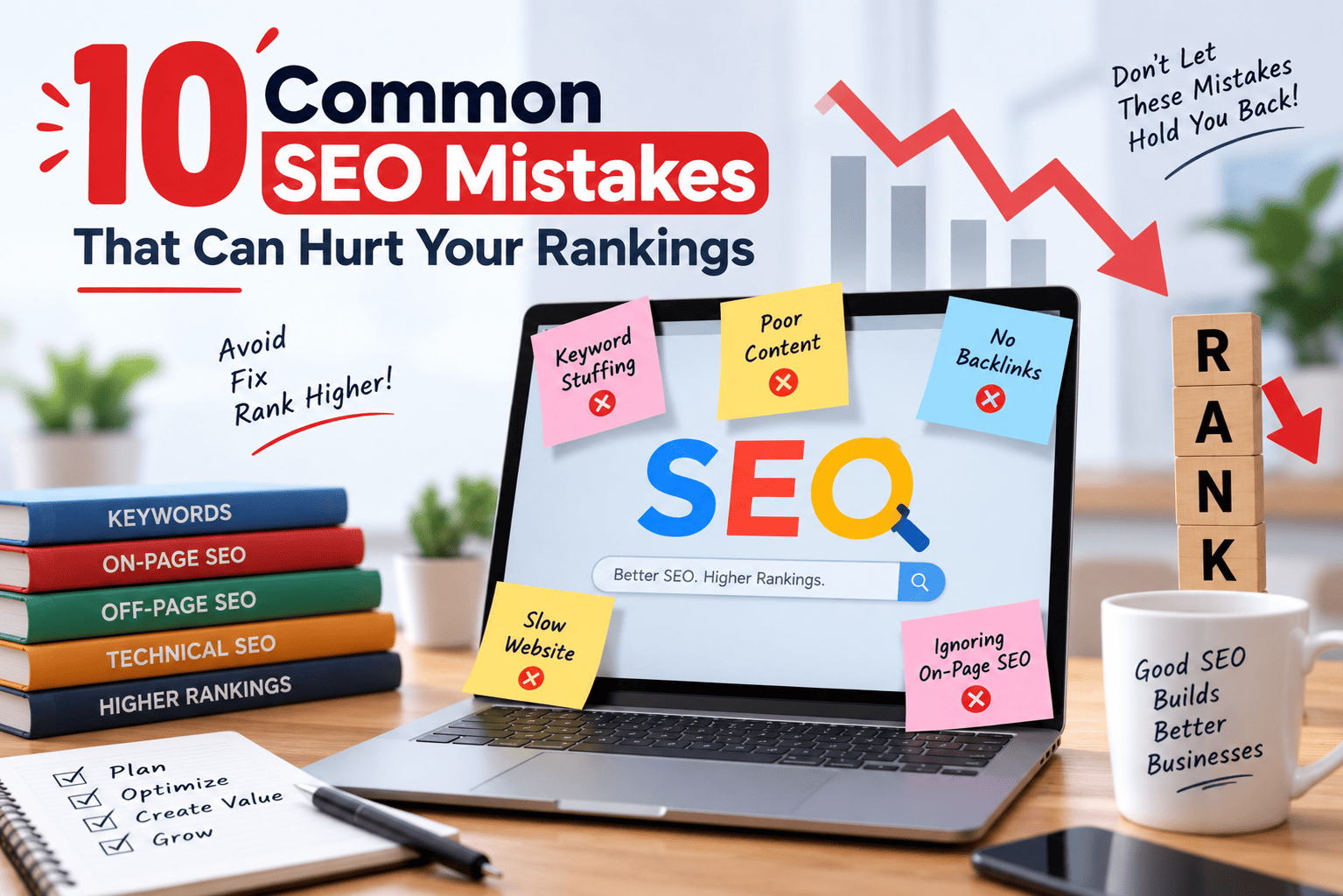
Search engine optimization (SEO) plays an important role in helping a website appear in search results and attract organic traffic. However, simply adding keywords and publishing content is not enough to achieve strong rankings. Many businesses unknowingly make SEO mistakes that can reduce their visibility, limit website traffic, and make it difficult for search engines to understand their website.
10 Common SEO Mistakes
Whether you manage a business website, an online store, or a blog, avoiding common SEO mistakes can help you build a stronger online presence. In this article, we explore 10 common SEO mistakes that can hurt your rankings and explain how you can avoid them.
1. Using the Wrong Keywords
One of the most common SEO mistakes is targeting keywords that do not match what your audience is actually searching for. Some businesses choose keywords simply because they have high search volume without considering search intent or competition.
For example, a small local business may struggle to rank for extremely competitive keywords when more specific, location-based keywords could bring highly relevant visitors.
Before creating content, research keywords based on search volume, competition, relevance, and user intent. Choose keywords that closely relate to your products, services, and target audience.

2. Keyword Stuffing
Keywords are important, but using them excessively can have the opposite effect. Keyword stuffing occurs when a keyword is repeatedly inserted into content in an unnatural way.
Search engines have become much better at understanding context and content quality. Repeating the same keyword dozens of times can make an article difficult to read and may negatively affect the user experience.
Instead, use your primary keyword naturally and include relevant variations and related terms. Write primarily for people rather than trying to manipulate search engines.
3. Ignoring On-Page SEO
On-page SEO involves optimizing individual web pages so that search engines and users can easily understand their content. Ignoring basic on-page elements is a common mistake that can prevent otherwise valuable content from performing well.
Important on-page elements include:
- Optimized title tags
- Meta descriptions
- Proper heading structure
- Relevant keywords
- Descriptive URLs
- Image alt text
- Internal links
- High-quality, useful content
Each important page should have a clear topic and structure. Make sure your title accurately represents the content and that headings help readers navigate the page.
4. Publishing Low-Quality or Thin Content
Creating large amounts of content does not automatically improve rankings. If your website contains short, repetitive, outdated, or unhelpful articles, it may fail to satisfy users’ needs.
High-quality content should answer the user’s question clearly and provide useful information. Instead of publishing several weak articles, focus on creating comprehensive resources that offer genuine value.
Regularly review older content and update statistics, examples, links, and information where necessary. Keeping content fresh can also improve its usefulness to visitors.
5. Neglecting Technical SEO
Technical SEO is another area that website owners often overlook. Even excellent content may struggle to perform if search engines cannot properly crawl, render, or index your website.
Common technical problems include broken links, duplicate pages, incorrect redirects, slow-loading pages, poor mobile usability, and indexing issues.
Regular technical SEO audits can help identify and fix these problems. Make sure your website has a logical structure, works properly on mobile devices, uses HTTPS, and allows search engines to access important pages.
6. Having a Slow Website
Website speed affects both user experience and SEO performance. Visitors generally expect websites to load quickly, particularly when browsing on mobile devices.
A slow website can increase bounce rates and make it harder for users to navigate your pages. Large images, unnecessary plugins, excessive scripts, poor hosting, and unoptimized code can all contribute to slow loading times.
To improve website speed, compress images, reduce unnecessary scripts, use browser caching, optimize your website’s code, and consider a reliable hosting provider.
7. Ignoring Mobile Optimization
A significant portion of internet users access websites through smartphones and tablets. If your website is difficult to use on smaller screens, visitors may leave quickly.
A mobile-friendly website should have responsive design, readable text, easy-to-use navigation, appropriately sized buttons, and content that fits different screen sizes.
Test important pages on multiple devices and screen sizes. Mobile optimization is no longer optional; it is an essential part of providing a good website experience.

8. Focusing Only on Off-Page SEO
Some website owners concentrate entirely on their website’s content and technical setup while ignoring activities outside the website.
This is where off-page SEO becomes important. Off-page SEO refers to activities performed outside your website that can help build authority, credibility, and visibility. Link building, digital PR, brand mentions, business listings, and other reputation-building activities can contribute to a strong SEO strategy.
However, quality matters more than quantity. Avoid purchasing large numbers of low-quality backlinks or participating in manipulative link schemes. Focus on earning relevant, trustworthy links from credible websites.
9. Forgetting Internal Linking
Internal links connect one page on your website to another. They help visitors discover related information and can also help search engines understand the relationship between different pages.
For example, a blog post about SEO basics could link to related articles about keyword research, technical SEO, or link building.
Use descriptive anchor text and link to genuinely relevant pages. A well-planned internal linking structure can distribute authority throughout your website and make navigation easier for users.
10. Not Tracking SEO Performance
Another major mistake is making SEO changes without measuring the results. Without tracking performance, it becomes difficult to understand what is working and what needs improvement.
Monitor important metrics such as organic traffic, keyword rankings, clicks, impressions, conversions, engagement, and indexed pages. Tools such as Google Search Console and Google Analytics can provide valuable insights into website performance.
SEO is an ongoing process. Rankings can change because of algorithm updates, competitors, changing search behavior, and website changes. Regular monitoring allows you to identify opportunities and respond to problems quickly.
How to Avoid Common SEO Mistakes?
Avoiding SEO mistakes requires a combination of good planning, quality content, technical optimization, and continuous monitoring. Start by understanding your audience and researching relevant keywords. Then optimize your website’s on-page elements, improve technical performance, create useful content, and develop a responsible off-page strategy.
It is also important to remember that SEO results rarely happen overnight. Sustainable SEO requires consistency and ongoing improvements rather than quick fixes.
If you are unsure whether your website has SEO problems, consider conducting a comprehensive SEO audit. An audit can identify technical issues, content gaps, on-page problems, backlink concerns, and other opportunities for improvement.
Final Thoughts
SEO can be highly effective for increasing organic visibility, but small mistakes can prevent your website from reaching its full potential. From keyword stuffing and poor content to technical issues and neglecting off-page optimization, there are many factors that can affect your search performance.
The best approach is to treat SEO as a long-term strategy. Focus on providing a great user experience, publishing valuable content, maintaining a technically sound website, and building your website’s authority naturally.
If you need help identifying SEO problems or improving your website’s search visibility, contact us to discuss your requirements and explore the right SEO strategy for your business.